
Picture this: You’re standing on a dusty trail in Indonesia, the tropical sun beating down, when suddenly you spot it. A massive, prehistoric-looking creature that seems to have walked straight out of a fantasy novel. Except this is no myth. This is a Komodo dragon, and you’re in its backyard.
I’ll be honest with you. When I first learned about these giant lizards, I thought people were exaggerating. The world’s largest lizard? Venomous? Can take down a water buffalo? Come on. But here’s the thing: every wild claim about Komodo dragons turns out to be true, and then some.
If you’re planning a family trip to Indonesia or you’re a backpacker looking to tick off one of nature’s most incredible encounters, you’ve landed in the right place. Let’s dive into the fascinating world of these ancient predators and discover what makes them so extraordinary in their natural habitat.
What Exactly Are Komodo Dragons?
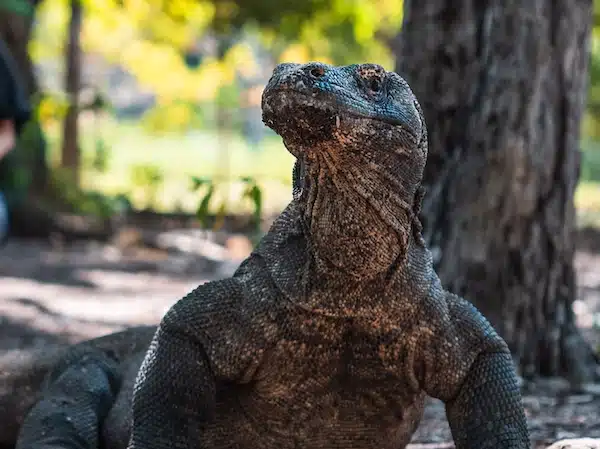
Let me start with the basics. The Komodo dragon (Varanus komodoensis, if you want to get scientific about it) isn’t actually a dragon. Shocking, I know. It’s a monitor lizard, but calling it “just a lizard” is like calling the Great Barrier Reef “just some coral.” These magnificent reptiles are the apex predators of their ecosystem, meaning they sit comfortably at the top of the food chain with no natural enemies.
Found primarily in Komodo National Park in Indonesia, these dragon lizards have been ruling their islands for millions of years. They’re living fossils, really. Evolutionary masterpieces that have perfected the art of survival. And before you ask, yes, they’re named after their home island of Komodo, which makes total sense when you think about it.
How Big Do Komodo Dragons Actually Get?
Alright, let’s talk size, because this is where things get properly impressive. An average adult Komodo dragon can reach lengths of up to 3 meters (that’s about 10 feet for those of you thinking in non-metric terms) and weigh anywhere between 70 to 90 kilograms. The largest verified specimen? A massive 3.13 meters long and weighing 166 kilograms. That’s heavier than most adult humans!
Here’s what really gets me: males are typically larger than females, which is pretty standard in the reptile world, but the size difference is substantial. Females usually max out around 2.4 meters, while males can push well beyond that.
Komodo Dragon Size Breakdown:
| Measurement | Average | Maximum Recorded |
| Length | 2.5-3 meters | 3.13 meters |
| Weight | 70-90 kg | 166 kg |
| Tail Length | 1.5 meters | Up to 1.8 meters |
| Height (standing) | 60-75 cm | 90 cm |
But size isn’t just about intimidation. It’s about efficiency. That powerful build, complete with muscular legs and a whip-like tail, makes them surprisingly agile hunters despite their bulk.
Where Do Komodo Dragons Live? (And Can You Visit?)
Here’s where your travel plans come into play. Komodo dragons are found exclusively on a handful of Indonesian islands: Komodo, Rinca, Flores, Gili Motang, and Padar. Their habitat isn’t some lush, Jurassic Park-style rainforest either. It’s hot, dry, and surprisingly rugged.
The Komodo dragon habitat consists of tropical savanna forests, beaches, and volcanic slopes. These aren’t picky creatures when it comes to terrain. I’ve read accounts of travelers spotting them lounging on beaches, wandering through grasslands, and even climbing trees (yes, climbing. We’ll get to that).
Komodo National Park is your best bet if you want to see these magnificent creatures. It’s a UNESCO World Heritage site, and for good reason. The park encompasses several islands and offers guided tours where you can safely observe Komodo island dragons in their natural environment. And trust me, you want that guide. These aren’t animals you approach casually.
For families and young travelers heading to Indonesia, combining a Komodo dragon expedition with island hopping around Flores makes for an unforgettable adventure. Just remember: these are wild animals in a protected national park, not a zoo exhibit.
What Do Komodo Dragons Eat? (Spoiler: Pretty Much Anything)
Let’s talk about the Komodo dragon diet, because this is where things get fascinating and slightly terrifying. These apex predators are carnivores with a menu that would make most predators jealous. We’re talking deer, pigs, water buffalo, smaller Komodo dragons (yes, they’re cannibalistic), birds, eggs, and occasionally carrion.
But here’s what makes them truly remarkable hunters: they’re opportunistic and patient. A Komodo dragon won’t always go for the dramatic takedown. Sometimes they’ll bite their prey and then follow it for days, waiting for the venom and bacteria to do their work. It’s brutal, efficient, and honestly quite clever.
Young Komodo dragons start their lives in trees, hunting insects, geckos, and small mammals. Baby Komodo dragons are actually vulnerable to predation from larger members of their own species, which is why they spend their first few years staying out of reach. Nature can be harsh like that.
What’s on the Menu:
- Large mammals: deer, wild boar, water buffalo
- Smaller prey: snakes, rodents, birds
- Opportunistic feeding: eggs, carrion, other Komodo dragons
- Occasional treats: fish, crabs (when near coastal areas)
An adult Komodo dragon can eat up to 80% of its body weight in a single meal. Imagine eating 60 kilograms of food in one sitting. That’s dedication to the craft.
Do Komodo Dragons Have Venom? (The Answer Might Surprise You)
For decades, scientists thought Komodo dragons killed their prey through septic bacteria in their mouths. The theory was simple: they’d bite, introduce nasty bacteria, and wait for infection to do the rest. Turns out, we were wrong.
In 2009, researchers discovered that Komodo dragons actually produce venom. Their lower jaws contain venom glands that secrete anticoagulants, causing prey to go into shock and preventing blood from clotting. The Komodo dragon venom is surprisingly sophisticated. It lowers blood pressure, causes massive bleeding, and prevents clotting. Combined with their serrated teeth and powerful bite, it’s a lethal combination.
But wait, there’s more. That bacterial theory wasn’t completely wrong. Their mouths are full of bacteria (over 50 different strains), so they’re essentially delivering a double whammy: venom and infection. Evolution really pulled out all the stops with these creatures.
How Do Komodo Dragons Hunt? (It’s Part Science, Part Art)
Komodo dragon hunting strategies are surprisingly sophisticated. These aren’t mindless eating machines. They’re calculated, patient predators with multiple techniques in their arsenal.
Their primary weapon is surprise. Despite weighing up to 90 kilograms, Komodo dragons can be remarkably stealthy. They’ll wait near watering holes or game trails, lying perfectly still for hours. When prey gets close enough, they explode into action with a burst of speed that seems impossible for their size.
Their sense of smell is extraordinary. Using their forked yellow tongues, they can detect carrion from up to 9 kilometers away. It’s like having a built-in GPS for food. They’ll sample the air with those tongues, collecting scent particles and processing them through a specialized organ in their mouth called the Jacobson’s organ.
Once they’ve made their attack, the Komodo dragon bite force (estimated at around 39 newtons at the rear teeth) combined with their venom is usually enough to bring down even large prey. If the initial attack doesn’t kill, they’ll track their victim, sometimes for days, until it succumbs.
How Fast Can Komodo Dragons Run? (Don’t Try to Outrun One)
Here’s something that might keep you up at night before your trip: Komodo dragon speed can reach up to 20 kilometers per hour in short bursts. That’s faster than the average human jogging pace, and definitely faster than most tourists scrambling over rocky Indonesian terrain.
But before you cancel your trip, let’s put this in perspective. They can’t maintain that speed for long. It’s purely for ambush attacks. These aren’t marathon runners; they’re sprinters built for explosive acceleration. In the wild, they typically move at a leisurely pace, conserving energy for when it really counts.
The good news? Park rangers and guides know their behavior patterns intimately. Follow their instructions, maintain the recommended distance, and you’ll be absolutely fine. These creatures aren’t interested in you as prey. You’re just an unusual visitor in their world.
Can Komodo Dragons Swim? (Island Hopping, Dragon Style)
You might assume these land-based giants stick to solid ground, but here’s a fun fact: Komodo dragons are excellent swimmers. They’ve been spotted swimming between islands, sometimes covering several kilometers of open ocean. It’s how they’ve managed to populate multiple islands across the Indonesian archipelago.
Their swimming ability is surprisingly graceful for creatures that look so prehistoric on land. They use their powerful tails to propel themselves through water, and they’re just as comfortable in coastal waters as they are on dry land. So if you’re on a beach in Komodo National Park and you think the water is a safe escape route, think again.
This aquatic ability also expands their hunting grounds. They’ll hunt fish and crabs in shallow waters, showcasing just how adaptable these creatures really are.
How Long Do Komodo Dragons Live?
The Komodo dragon lifespan in the wild is typically around 30 years, though some individuals have lived longer in protected environments. In captivity, with veterinary care and consistent nutrition, they can reach 40 years or more.
Think about that for a second. These creatures can outlive many pets and witness an entire human generation grow up. The oldest known Komodo dragon in captivity lived to be over 50 years old, which means it witnessed the rise of the internet, several fashion cycles, and probably had better consistency in its life than most of us.
Are Komodo Dragons Dangerous to Humans?
Let’s address the elephant in the room, or rather, the 150-kilogram lizard. Yes, Komodo dragons are dangerous to humans, but Komodo dragon attacks on people are relatively rare. Between 1974 and 2012, there were only a handful of recorded fatalities, though attacks resulting in injuries are more common.
Here’s the reality: these are apex predators with powerful jaws, sharp teeth, and venom. They deserve respect and caution. But they’re not mindless killing machines hunting tourists. Most attacks occur when people get too close, attempt to feed them, or surprise them unexpectedly.
Safety Tips for Visitors:
- Always hire a certified guide when visiting Komodo National Park
- Never approach a Komodo dragon on your own
- Keep children close and supervised at all times
- Don’t bring food into viewing areas (they have incredible smell)
- If you encounter one unexpectedly, back away slowly. No sudden movements
- Women on their menstrual cycle should inform guides (dragons can detect blood)
The park rangers carry large forked sticks for a reason. Not to attack the dragons, but to gently redirect them if they get too curious. These guides know the individual dragons, their temperaments, and their territories. Trust their expertise.
Do Komodo Dragons Lay Eggs? (Baby Dragons Are a Thing)
Komodo dragon reproduction is fascinating, and yes, they lay eggs. Females dig nests in the ground or take over megapode nests (those are mound-building birds), laying clutches of around 20 eggs on average. The incubation period lasts about 7 to 8 months, which is a long time to keep eggs safe from predators.
Here’s where it gets really interesting: Komodo dragons are capable of parthenogenesis, which is basically virgin birth. Females can reproduce without males through a process where their eggs develop into embryos without fertilization. The offspring are always male, which scientists believe is nature’s way of ensuring the species can rebound even if populations get separated.
Baby Komodo dragons are incredibly vulnerable when they hatch. At only about 30 centimeters long, they’re prey for just about everything, including adult Komodo dragons. That’s why young dragons spend their early years in trees, living off insects and small animals until they’re large enough to defend themselves on the ground.
Are Komodo Dragons Endangered?
Unfortunately, yes. Komodo dragons are listed as Endangered on the IUCN Red List. Current estimates suggest there are around 3,000 to 5,000 individuals left in the wild, with populations facing threats from habitat loss, human encroachment, poaching of their prey species, and climate change.
Komodo dragon conservation efforts are ongoing and surprisingly successful in some areas. Komodo National Park provides crucial protected habitat, and tourism (when managed responsibly) actually contributes to conservation funding. Your visit, done correctly, supports the preservation of these incredible creatures.
The Indonesian government and international conservation organizations are working together to ensure these ancient reptiles don’t disappear. Breeding programs, habitat protection, and local community engagement are all part of the strategy to keep Komodo dragons thriving.
Komodo Dragon vs Crocodile: Who Would Win?
I know someone’s thinking it, so let’s address it. In a hypothetical Komodo dragon vs crocodile matchup, the environment would determine everything. In water? The crocodile wins, no contest. Crocodiles are aquatic specialists with crushing bite forces and drowning tactics that no land-based predator could counter.
On land? It gets more interesting. A Komodo dragon’s venom, agility, and endurance would give it advantages, but a large saltwater crocodile still has a more powerful bite force (around 3,700 PSI compared to the Komodo’s estimated 600 PSI). Realistically, these animals occupy different ecological niches and would likely avoid each other in nature.
But honestly, the fact that we’re even comparing a lizard to a crocodile tells you everything about how formidable Komodo dragons are.
What Makes the Bite Force of a Komodo Dragon Special?
We’ve touched on this, but the bite force of a Komodo dragon deserves its own moment. While not as powerful as a crocodile’s, it’s incredibly effective for what these creatures need. Combined with their serrated teeth that curve backward (designed to tear flesh), their bite is devastating.
But here’s what scientists find fascinating: it’s not just about force. The way their skulls are structured, with relatively weak jaw-closing muscles, suggests they rely more on their venom and the sawing motion of their serrated teeth than pure crushing power. They’re basically using a steak knife approach rather than a nutcracker strategy.
Their teeth also constantly replace themselves throughout their lives. They can go through multiple sets, similar to sharks. Any tooth lost in a struggle just grows back. Convenient, right?
Planning Your Visit: Where to See Komodo Dragons in the Wild
If I’ve convinced you that seeing these magnificent creatures is worth the journey (and I hope I have), here’s what you need to know about where to see Komodo dragons:
Best Locations:
- Komodo Island: The most famous spot, with the highest concentration of dragons
- Rinca Island: Often less crowded, with equally impressive dragon populations
- Flores: Some areas, particularly the western coast
- Gili Motang: Smaller population, more remote
When to Visit: The dry season (April to December) is ideal. The dragons are more active, and hiking conditions are better. Peak tourist season runs from June to August, so if you want smaller crowds, consider May or September.
What to Expect: Tours typically last 2 to 4 hours and involve hiking through dragon territory with an armed guide. You’ll almost certainly see multiple dragons, from juveniles to massive adults. Photography is encouraged, but always from a safe distance.
Getting There: Most visitors fly into Bali, then take a connecting flight to Labuan Bajo on Flores. From there, it’s a boat trip to Komodo National Park. Budget 3 to 4 days minimum for the full experience, including travel time.
The Bottom Line: Why Komodo Dragons Matter
Here’s what I want you to take away from all this: Komodo dragons aren’t just oversized lizards or tourist attractions. They’re evolutionary marvels. Living proof that sometimes the old ways are the best ways. In a world where we’re losing species at an alarming rate, these ancient predators are still here, still thriving (relatively), and still captivating everyone who encounters them.
For families traveling with curious kids, this is education you can’t get from textbooks. For backpackers collecting once-in-a-lifetime experiences, this checks a box most people don’t even know exists. And for anyone who appreciates the wild, untamed beauty of nature, Komodo dragons represent something increasingly rare: a creature that hasn’t been domesticated, diminished, or Disney-fied.
These dragons have survived volcanic eruptions, climate shifts, and human expansion. They’ve been perfecting their craft for millions of years while the rest of us were still figuring out how to walk upright. That deserves respect, protection, and (if you’re lucky enough to visit) your absolute attention and wonder.
Ready for Your Dragon Encounter?
So there you have it. Everything you need to know about Komodo dragons in their natural habitat, from their impressive size and hunting prowess to their conservation status and where you can safely observe them. These creatures are reminders that our planet still holds mysteries worth protecting, adventures worth taking, and stories worth sharing.
If you’re planning your Indonesian adventure, make Komodo National Park a priority. At Pirate Journey, we’ve curated the best Komodo Island experiences with certified guides and responsible tour operators who prioritize both your safety and wildlife conservation. Whether you’re traveling with family or backpacking solo, we’ll help you turn this bucket-list dream into reality. Trust me, standing in the presence of the world’s largest lizard is an experience that photos don’t quite capture. You have to feel that mix of awe and healthy fear to truly understand what makes these creatures so extraordinary.
Ready to book your dragon encounter? Head over to Pirate Journey and start planning the adventure of a lifetime. Who knows? Maybe thirty years from now, you’ll be telling your own kids or grandkids about the time you stood meters away from a real dragon. And unlike most dragon stories, this one will be completely true.